
Introducing FLUX-mimic: Scaling Video-Action Models for General Purpose Dexterity
Elvis Nava, Oliver Sanchez, Stefanos Charalambous, Eugenio Chisari, Fabio Quattrini, Sigmund Høeg, Nico Gürtler, German Rodriguez, Mario Arduini, Thomas Umbach, Michael Blösch, Aashna Majmudar, Stephan-Daniel Gravert, Stefan Weirich / July 23, 2026
Today we are proud to announce our collaboration with Black Forest Labs, and to showcase a preview of FLUX-mimic, a next-generation Video-Action Model for general purpose dexterity, enabling robots to learn and perform complex manipulation tasks in real-world industrial environments. FLUX-mimic is a model for general-purpose robot action generation, trained on top of FLUX 3, the new frontier multimodal image, video and audio generation model by Black Forest Labs. We are already testing and deploying FLUX-mimic with manufacturing leaders like Audi.
Within the realm of knowledge work, foundation models now let a single person create, code, and reason with the output of a whole team behind them. The physical economy: the larger share of global GDP, the part that actually builds and moves things, hasn't had that moment yet, and it has become the bottleneck on almost everything we want more of: housing, energy, infrastructure, goods. Traditional robotics was never going to break it.
Something new is emerging to fill this gap: an approach founded on applying frontier advances in generative modeling to build truly general-purpose robots. The goal: create robotic systems that can be deployed in minimal time to handle arbitrary physical labor. So far, robot learning and Vision-Language Action models (VLAs) have been inhibited by model architecture limitations, data scarcity, performance reliability and deployability. At mimic, we’re pioneering what comes next.
We introduced Video-Action Models (VAMs): multimodal generative models that combine video and world modeling with robotic action prediction. Leveraging the visual, semantic, behavioral and physical priors learnable from scaled-up video generative modeling, VAMs learn robot action prediction with as much as 10x improved data efficiency. Beyond performance, they unlock a future in which world understanding, physical dynamics prediction and action are unified and scaled together, paving the way for even more interesting robotics capabilities, from test-time computation to video in-context learning.
This architectural bet reflects our data bet. Last week, when we introduced our mimic hand M1, the wearable U1 and our frontier middleware, we described the concept of our robotics “data pyramid”. At its base sits video of humans doing physical work: available at enormous scale, but with no robot actions attached. In the middle, demonstrations recorded with our wearable U1: human hand motion captured in robot-compatible form, without needing a robot. At the top, teleoperation and deployment data from robots: by far the scarcest. A VLA can only train on the top two layers of this pyramid, where actions exist. A VAM, on the contrary, can fully leverage massive video pre-training and its derived priors of physical interaction and human behavior.
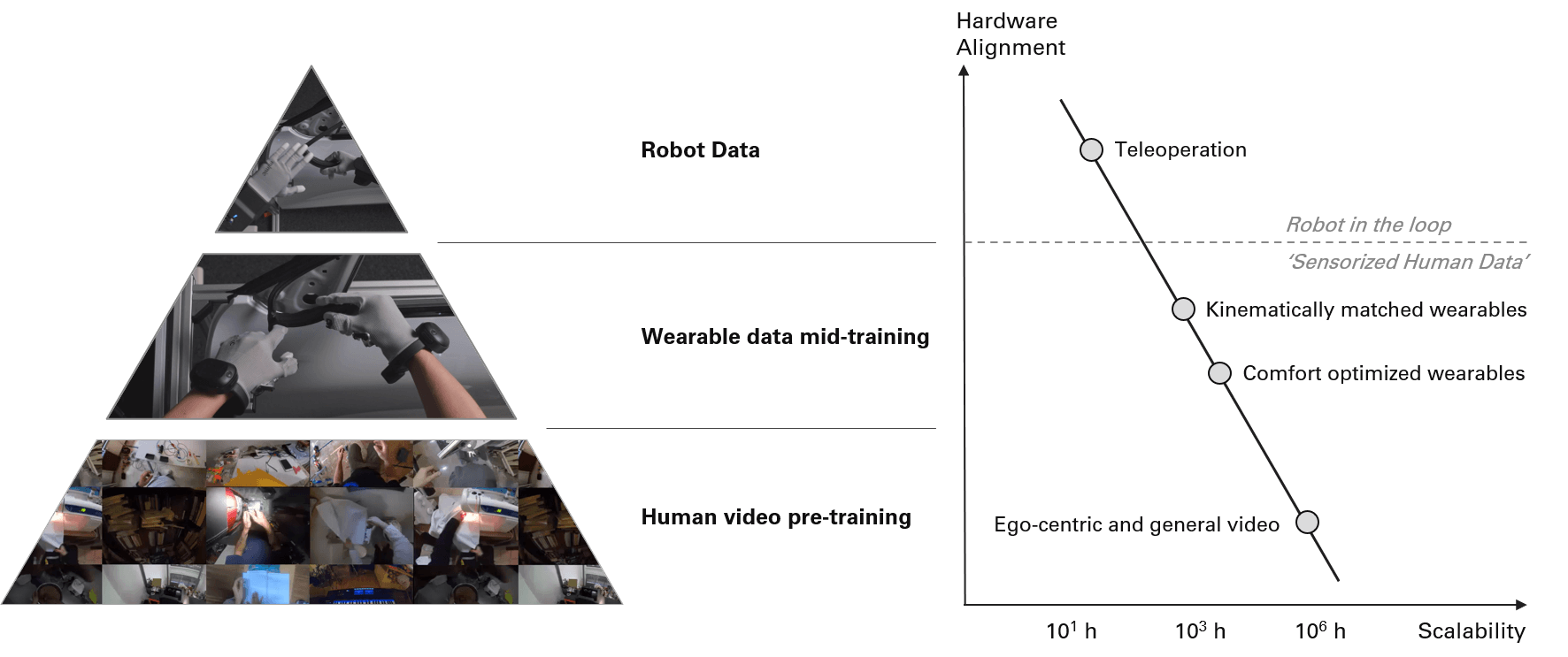
Partnering with Black Forest Labs and developing FLUX-mimic is the logical next step of pursuing this thesis. Today, Black Forest Labs announced FLUX 3, a multimodal image, video and audio generation model sitting at the frontier of generative model capabilities. On its own, it serves as the strongest possible foundation for the base of our data pyramid. Combining it with mimic’s state of the art model recipes and data for the middle and top layers of the pyramid, we obtain FLUX-mimic, pushing the frontier of robotics foundation models.
This is not just research: FLUX-mimic is already meeting the factory floor. Together with leading automotive and manufacturing partners like Audi, we are testing and deploying it on real production use cases, such as soft-body manipulation tasks that were previously considered impossible for conventional automation.
Our Bet on Video-Action Models
Stating that large scale human video data needs to be the bedrock of robot pre-training is one thing, actually making it work is something else entirely. Within the Vision-Language-Action (VLA) framework, models must be trained on low-dimensional action trajectories, which are difficult to stably extract from human video and overall carry limited information. mimic instead bets on video pre-training as the key behind learning generalizable physics and manipulation priors from this data.
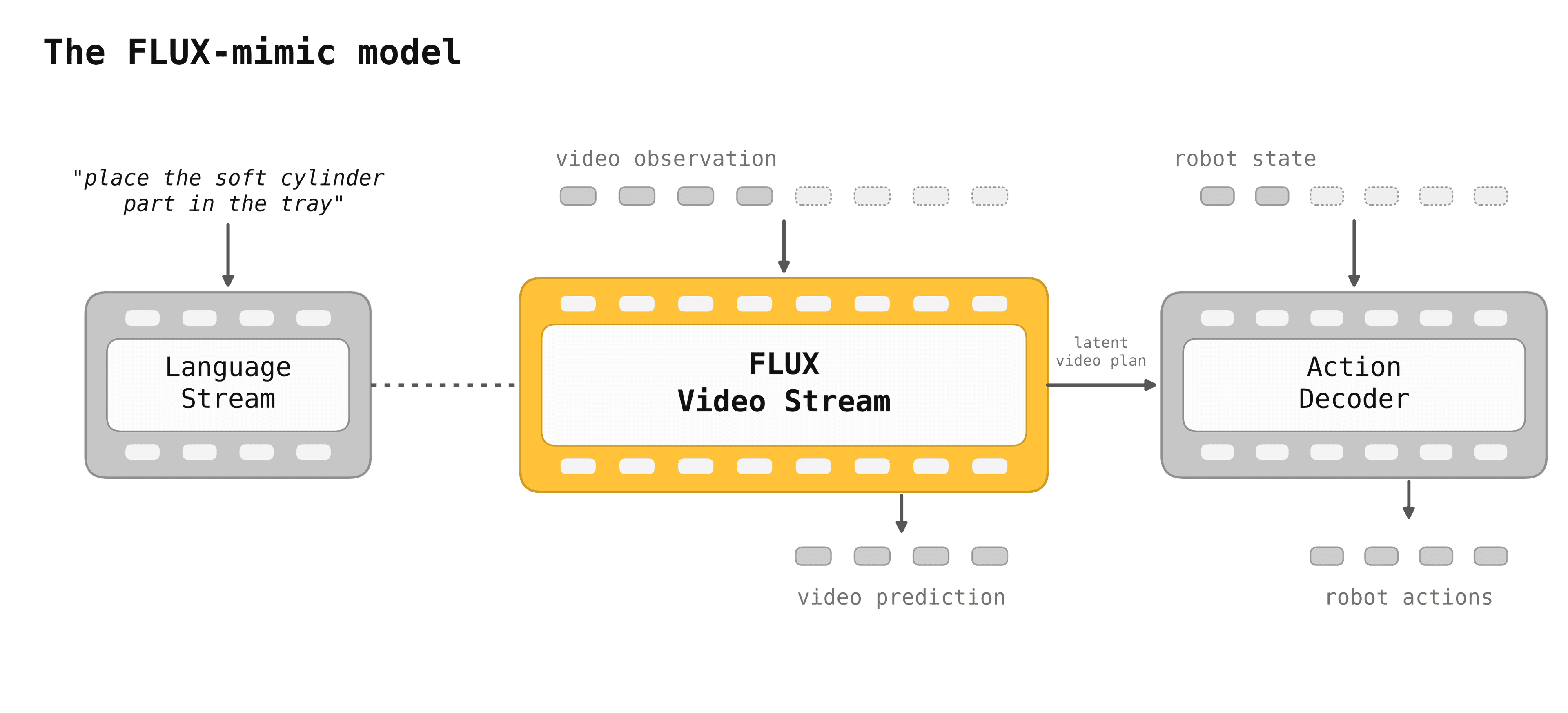
In our seminal work mimic-video, we introduced the Video-Action Model (VAMs), a novel family of robot action generation models based on top of pre-trained video generation models. Traditional VLAs build on top of VLMs, which are pre-trained on static image-language data. These models have to learn fine-grained behavior and physical dynamics entirely from expensive low-dimensional robot action data and benefit from VLM pre-training only in a limited way. Instead, a generative video model is an extremely rich source of learned representations for physical interaction and human behavior priors: it can jointly model semantics, physical dynamics and high-level behavior in pre-training, without ever seeing low-dimensional robot action data, which is often hard to acquire for large scale human datasets. Only in a second phase did we train an action decoder, which served as an Inverse Dynamics Model (IDM) on top of latent video plans.
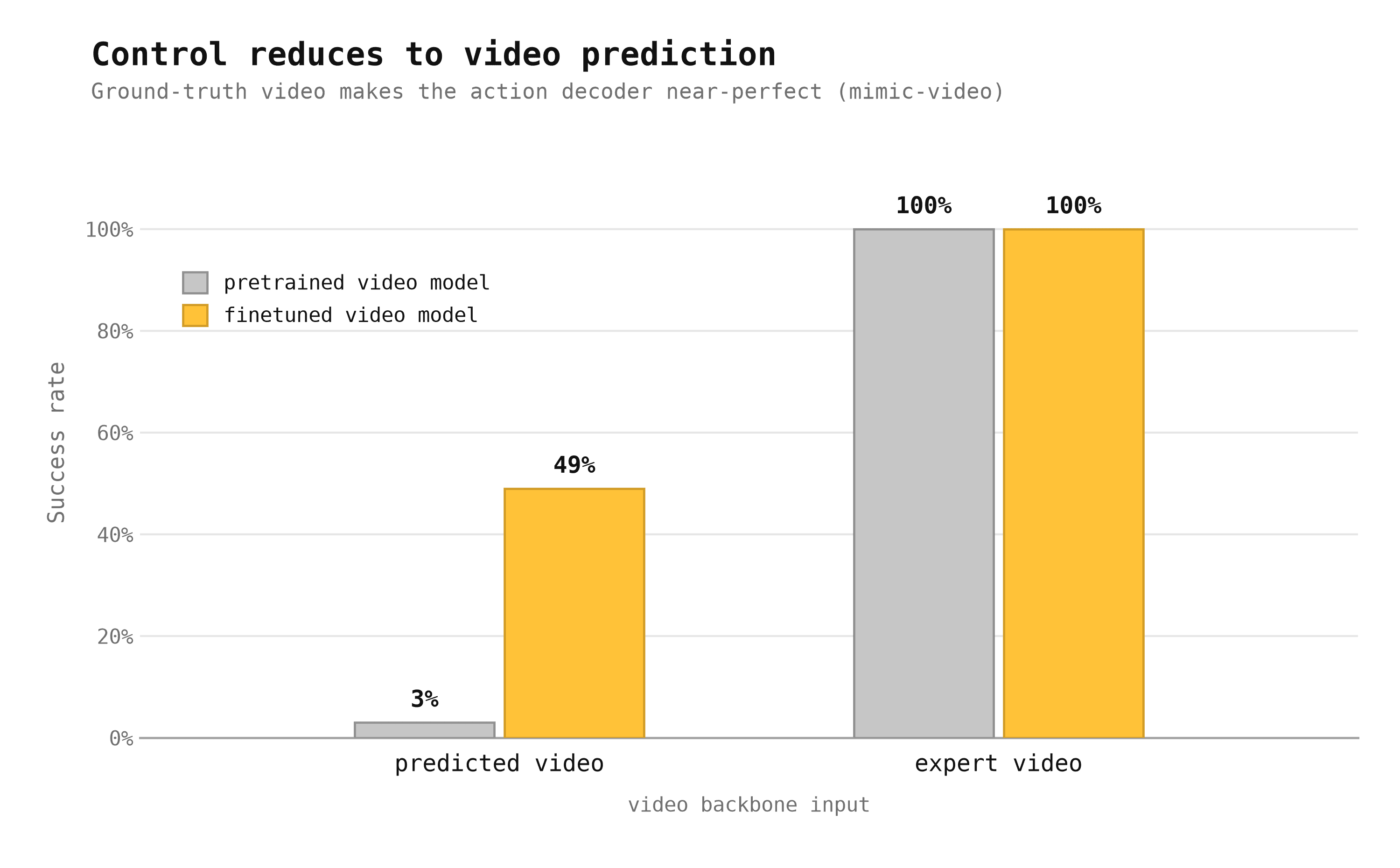
What we observed in mimic-video is that even with minimal action data, we were able to reach higher success rates compared to a traditional VLA recipe, reaching overall 10x higher sample efficiency and 2x faster convergence. Moreover, we were able to demonstrate that model performance for action prediction is fully downstream of video model strength. To do so, we orchestrated an “oracle” experiment: giving ground truth future video as input to our video model backbone, we observed that the generated actions from the action decoder result in approximately perfect performance. Control effectively reduces to visual prediction, implying policy performance scales directly with the quality of video model predictions.
For this reason, we believe that the biggest gains to come in robot learning will come from the repurposing of frontier video models into Video Action Models. We believe that increasingly better video and world models will directly translate into improved action prediction performance and generalization. More importantly: better video models can help us leapfrog any level of “robot action”-only pretraining. This is why we partnered with Black Forest Labs. Their new FLUX 3 model advances the state of the art of video generative models, and already incorporates human video and robot video data at scale in its training pipeline.
Building FLUX-mimic on Top of FLUX 3
FLUX-mimic is our next-generation Video-Action Model, built on top of Black Forest Labs’ FLUX 3 video backbone and trained on our robot manipulation data. The backbone predicts how a manipulation scene will evolve; a compact action decoder attends to the backbone's internal representation of that predicted future and denoises chunks of robot actions directly from these latent video plans. Because the decoder reads latent features rather than generated pixels, action generation requires only a single forward pass of the video model and no video rollout at inference time. And because the backbone remains a full generative video model, we can train it on joint video-action prediction, letting the model keep improving as a world model while it learns to act. In our latest evaluations, training the full video backbone rather than freezing it consistently improves performance.
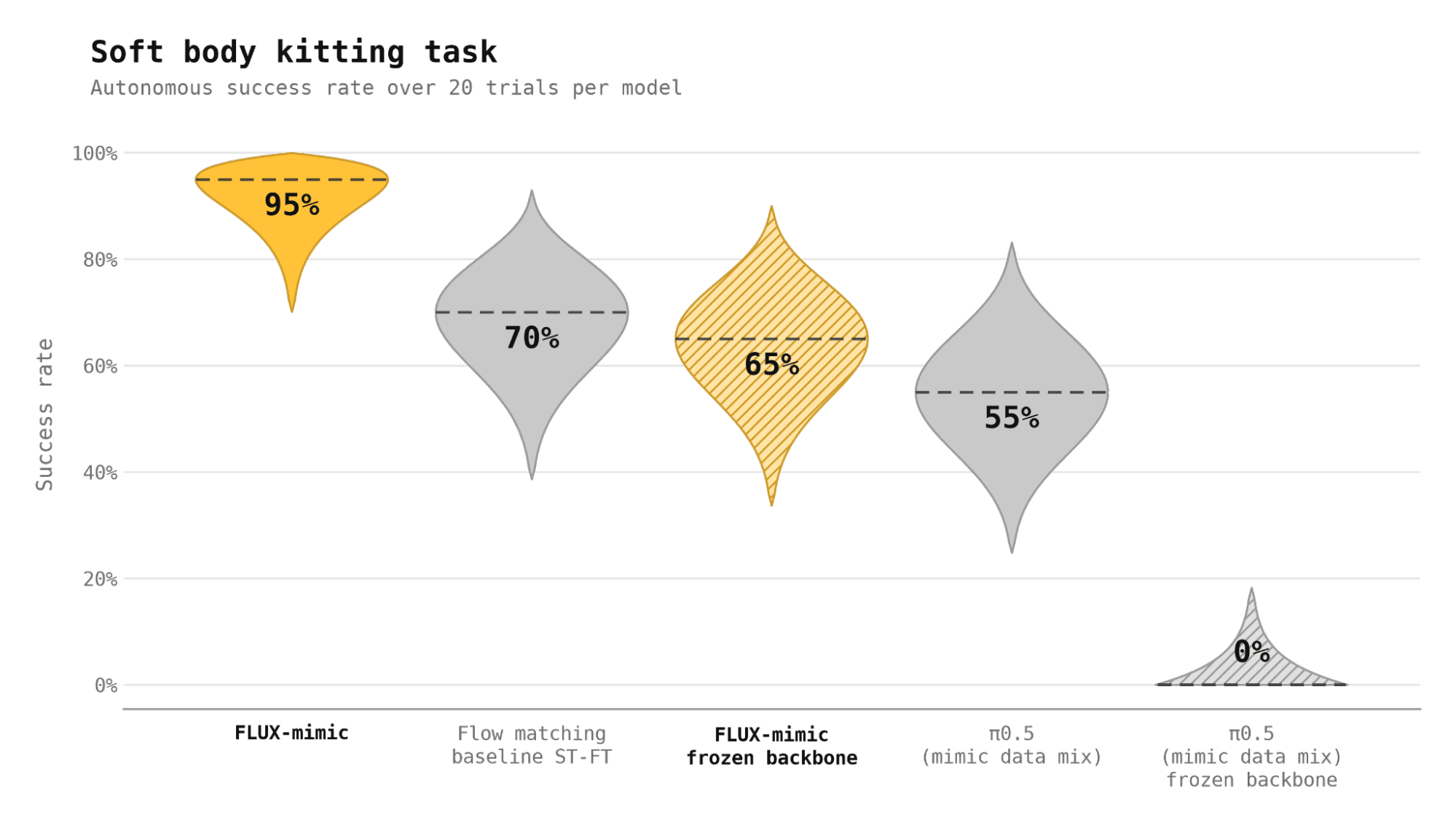
We benchmarked a preview version of FLUX-mimic on a soft body kitting task on our real robot, where we obtained 95% success rates out of the box with no single task fine-tuning or post-training, compared to 55% success rates from an adapted version of pi0.5 trained on our data mix, and 70% from a Flow Matching baseline policy heavily post-trained on this single task. Even with a frozen backbone, FLUX-mimic remained competitive while the pi0.5 action decoder fell to 0%. Success rate was calculated by counting the number of overall correct task completions for multi-step kitting.
To specifically tailor our model to industrial use cases, mimic is partnering with global automotive and manufacturing players to benchmark frontier model developments directly on real industry needs. We collected large scale high quality data on more than 100 real factory use cases. The data was collected as a mix of teleoperation on our mimic robots and human data on wearable systems. When adding this data to our video and action training mix, we were able to consistently improve model performance on these families of industrial tasks.
Pushing the Limits of Real-time Inference on Device
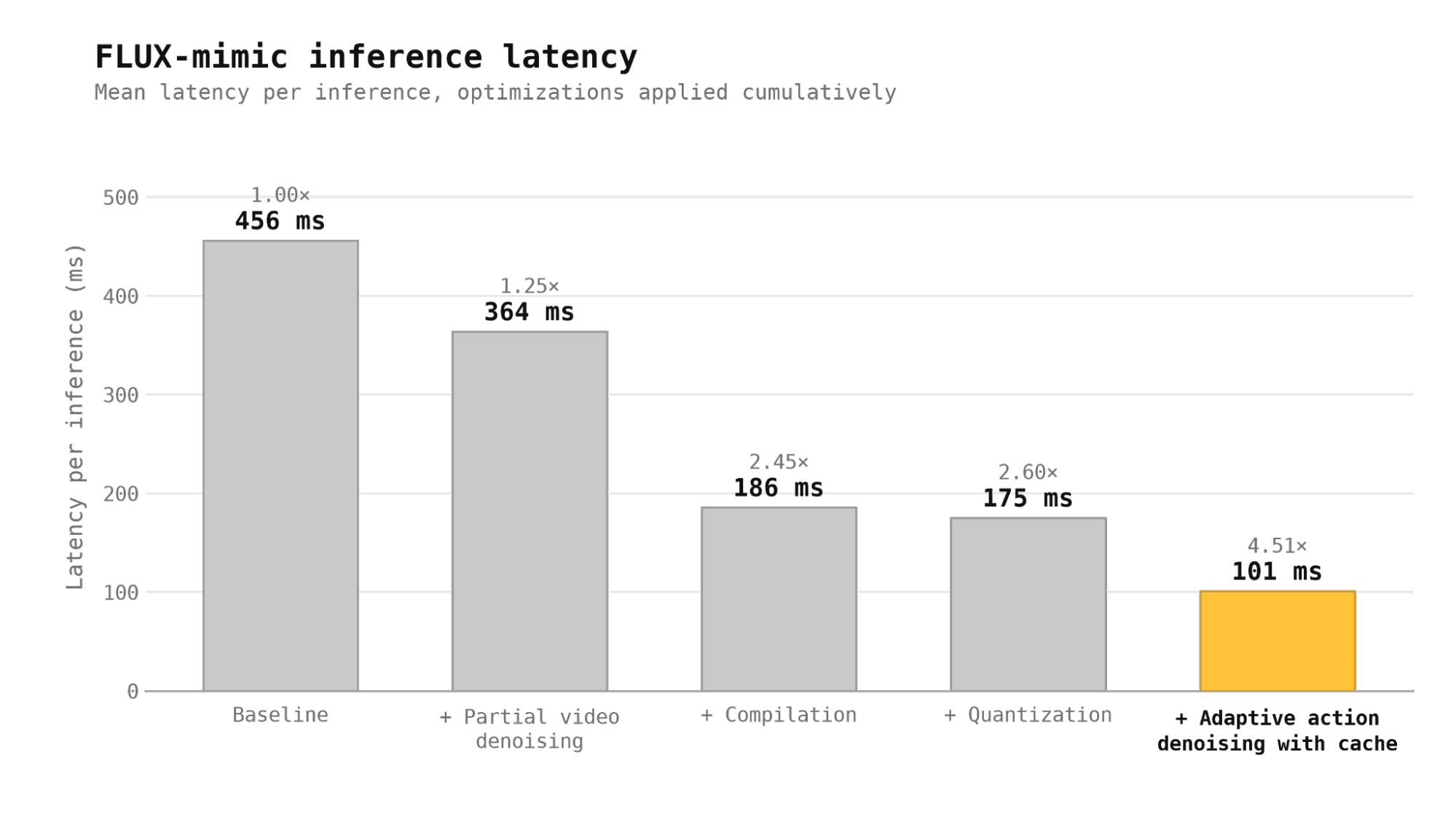
Superficially, a video model seems like the wrong candidate for a robot policy. Robots need a continuous stream of actions under tight latency bounds, while video models are known for high latency and heavy compute demands. Taken at face value, this combination suggests that VAMs belong in a datacenter rather than on a robot. Yet FLUX-mimic runs locally on the robot in production, on a single NVIDIA RTX 5090 GPU, fully on the edge.
The design decisions and inference optimizations that made this possible are as follows:
- Partial video denoising
- FLUX-mimic never generates video at inference time. Its action decoder attends to the video backbone's internal representation of the predicted future directly, so a chunk of actions costs a single forward pass of the backbone rather than a full video rollout.
- Post-training quantization
- We aggressively quantize the video backbone for deployment, and validate the compressed checkpoint against the original model.
- Real-Time Chunking (RTC)
- RTC enables prediction and execution to overlap while maintaining trajectory smoothness across action chunks.
- Adaptive action denoising with cache
- During inference, FLUX-mimic can skip denoising steps when consecutive velocity predictions are similar. Cached context from the video backbone is reused throughout the action decoding.
Fast inference alone is not enough. A policy is only as good as the observations that reach it: sensor data that arrives late or out of sync degrades policy performance just as surely as a slow forward pass. This is where the full-stack approach pays off again. Our mimic-ipc middleware moves observations and actions between sensors, model and actuators with minimal latency and jitter, so the model always acts on a fresh view of the world, and its actions reach the hardware without delays.
Working on Real Factory Use Cases
Achieving high benchmark scores is not the same as shipping robots. From the beginning, we have developed FLUX-mimic against real factory use cases, on real production parts, together with manufacturing partners across the automotive industry and beyond. The tasks span the daily reality of production and logistics work: kitting parts into structured trays, inserting electronic components into tight-fitting fixtures, assembling different parts, and manipulating soft, flexible materials like seals and cables that conventional automation has never been able to handle.
Our Partnership with Audi
One of these partners is Audi. Together with Audi, we have been testing and deploying FLUX-mimic on real production use cases, including the assembly work shown below.
Autonomous policy execution on Audi car door assembly task
What our partners need is automation that is flexible, reliable, and quick to integrate, a system that slots into an existing line without months of integration efforts. This is what FLUX-mimic is built to deliver: deploying a new task only requires a few hours.
“We have seen these robots solve complex soft body manipulation work that would have been simply impossible with conventional robotics. For us, partnering with pioneering companies such as mimic and Black Forest Labs is essential in pushing the frontier of Physical AI and validating these innovations in real-world production environments,”
Closing the Reinforcement Learning Post-Training Loop
While imitation learning at scale leads to stronger generalists and more robust recovery behaviors, these policies often struggle with out-of-distribution tasks. To achieve deployment-ready performance on unseen tasks, we use post-training methods that gather experience on target tasks and iteratively improve performance.
Independent of the base model, we have built our own RL post-training infrastructure to leverage data from live robot execution for iterative self-improvement. Since deployment provides a growing stream of data at no additional cost, utilizing this information to refine policies is crucial. While teleoperated demonstrations establish core behaviors, autonomous post-training bridges the gap to target tasks by using deployment data to minimize errors and speeds up task completion beyond the limitations of a human teleoperator.
To achieve rapid improvements, we leverage sample-efficient off-policy RL built on pre-trained representations. We extend the policy architecture and train a critic to provide a value function that scores states within rollouts. This value function allows us to improve the policy both during rollout, such as through best-of-n selection, and through ongoing policy refinement.
RL post-training reward function during policy execution
A Future of Freeform Promptability
Today’s robot policies are adapted to new tasks by fine-tuning and post-training on collected task demonstrations. But a policy built on a video model does not have to stop there.
In-context learning capabilities from multi-modal generative models will allow for arbitrary but precise “prompting interfaces” for these physical AI models. Rather than fine-tuning models or using language prompts, we will be able to provide motion sketches, goal images or video demonstrations to give robots precise context and instructions without touching a model’s weights. “Language is the universal interface” is too reductive in the world of robotics and video models, where most instructions are better conveyed by direct demonstration. For FLUX-mimic, this is not a speculative interface: its backbone is a conditional video generator, and a goal image or a video demonstration is exactly the kind of context it was built to consume. We are actively planning such capabilities in future versions of the model.
With this new type of human-machine interaction, commanding robots or physical AI agents will be open to anyone without prior training. Several robotic agents can make a single worker much more productive, similar to how we use agents to help us with specific tasks in digital domains such as coding.
Conclusion
2026 so far has demonstrated that demand for intelligence is insatiable. We argue that similarly, demand for “getting stuff done” in the physical world will also soon be insatiable.
When general purpose robotics works, it will be useful in a way that is hard to imagine. With robots seamlessly integrating into human workflows, and augmenting them with an unprecedented combination of repeatability and contextual promptability, we will change the laws of manufacturing and the way factories are built. Manufacturing will transition towards maximum flexibility and products will be endlessly customizable. Lowering production costs will usher in a new demand boom for consumer goods, infrastructure build-up and the built environment.
Framing general purpose robotics as a matter of addressing labor shortages is reductive, as it implies us merely coping with a diminishing supply of labor while maintaining a constant or barely growing economic output. The truth is that if the physical labor supply can truly be arbitrarily expanded, humanity will want more things to be done, assembled, packaged, manufactured, built. We can make a world possible where standards of living could be simply bounded by availability of raw materials and energy.
None of this vision can be simply demanded, it must actively be built. FLUX-mimic is our next step: the Video-Action Model recipe we pioneered with mimic-video, applied to a frontier video model from Black Forest Labs, running on our own hardware, fed by our own data flywheel, and proving itself on real production use cases today. Our conviction from mimic-video holds more than ever: control reduces to video prediction, and every advance in video models now translates directly into more capable robots.
FLUX-mimic is a preview, and it is just the beginning. If you want to build with us, please check out our open roles.