
Solving Dexterity: A Full-Stack Approach
Stephan-Daniel Gravert, Philipp Wand, Benedek Forrai, Julian Lotzer, Nicolas Längerich, Manuel Meier, Stephan Polinski, Aashna Majmudar, Stefan Weirich, Elvis Nava / July 16, 2026
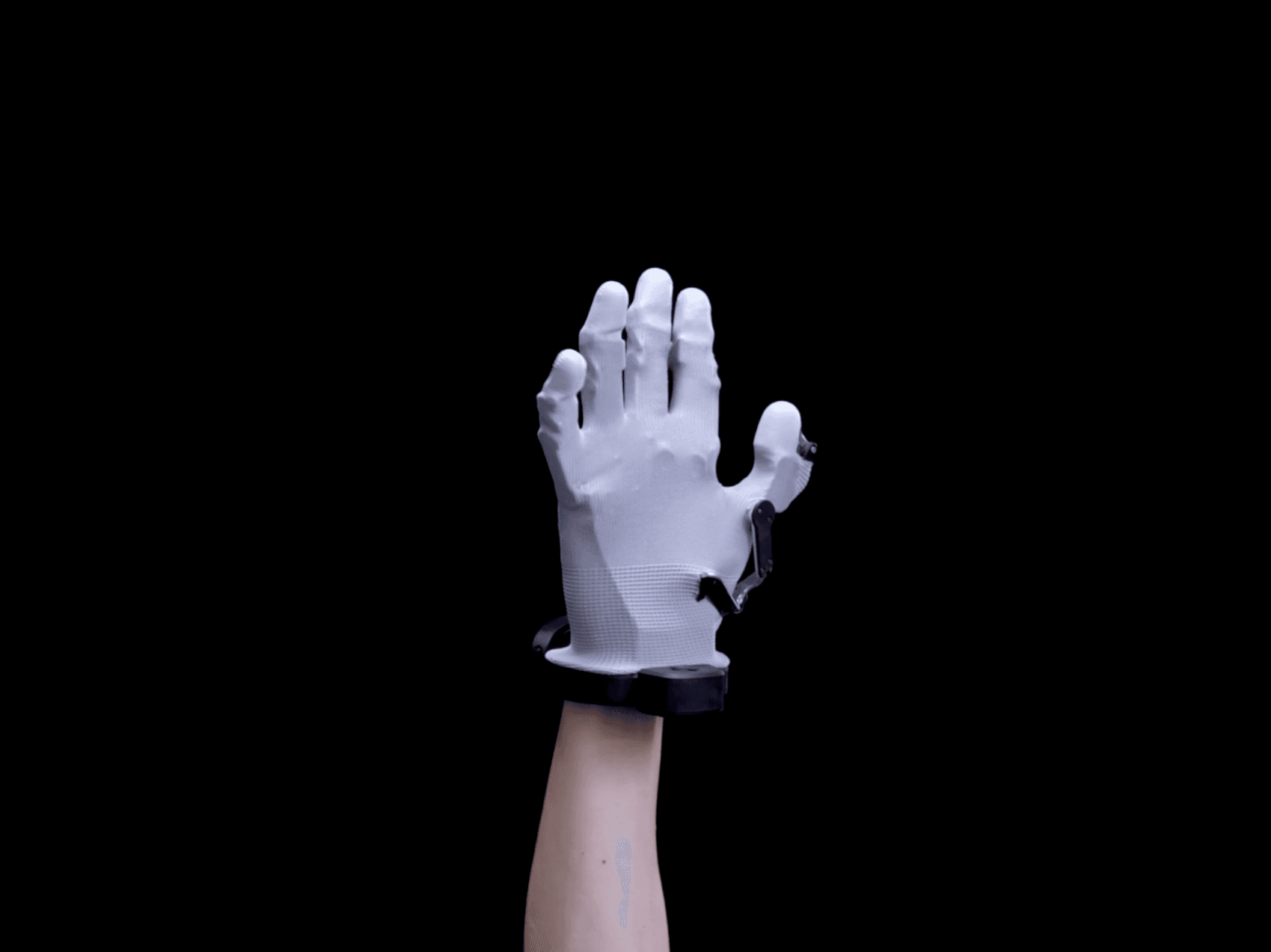
mimic robotics unveils the mimic hand M1 and mimic wearable U1, a full-stack physical AI platform for general-purpose dexterous manipulation.
Today we are proud to announce the mimic hand M1, our highly backdrivable, tendon-driven robotic hand designed and built in-house for industrial automation. Alongside it, we are introducing the mimic wearable U1 (“umimic”), our exoskeleton that captures human demonstrations directly matched to the kinematics of mimic hand M1. Together with our fully in-house developed software stack, these systems provide an integrated platform to enable general-purpose dexterous manipulation.
From day one, mimic has been laser-focused on the single goal of general-purpose dexterous manipulation. We believe that the only way to solve general-purpose manipulation while creating value at scale is to take the “full-stack approach”. Deploying autonomous fleets of robots will depend on vertically integrated stacks with full hardware observability, just as full vertical integration mattered in autonomous driving.
Every serious attempt to bring foundation models to the physical world runs into the same wall: robotics has no equivalent to internet-scale training data. So an optimal approach must draw on multiple sources and combine data across qualities and quantities. What pre-training delivers is representations - visual, semantic, behavioral, and physical. The largest source of behavioral and physical priors at meaningful scale is large-scale video of humans. For post-training, nothing beats the robot: live deployment data and teleoperation, collected on the target hardware in the target environment.
However, the embodiments of traditional two-finger gripper robots and the human embodiment are fundamentally mismatched. If we ground pre-training in human video and then deploy a two-finger gripper, we introduce a cross-embodiment gap that renders our pre-training and post-training phases misaligned: the end effector is different, and the discrete steps a human takes to manipulate an object are not the same a two-finger gripper would need to take.
We never introduce this cross-embodiment gap in the first place. We hold morphology constant across every phase of learning by running the entire pipeline on hands. This is the bet we are making at mimic.
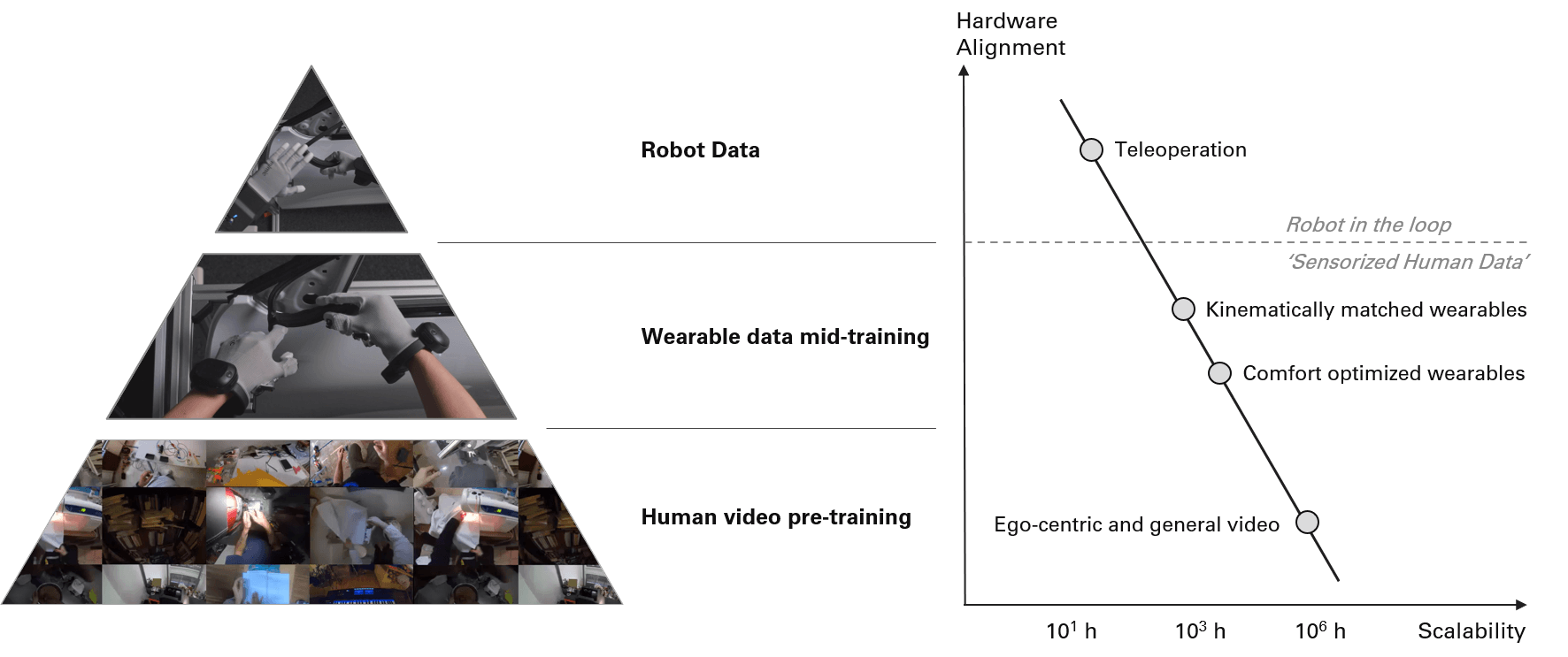
To balance our human data needs across qualities and quantities, we developed a strategy based on a “data pyramid”. At the base of the pyramid sits human video data: lower quality per sample, but available at massive scale. In the middle, wearable device data: higher quality than pure arbitrary egocentric video, but easier to scale than robot teleoperation. And only at the top, robot teleoperation and deployment data: the highest quality of data, collected directly with our own robots.
mimic hand M1
Solving general-purpose dexterous manipulation requires a general-purpose robotic hand, one that covers the full range of human capability: precise and sensitive tasks, heavy payloads, and resistance to severe collisions, all with the same system. The mimic hand M1 is our answer, designed and manufactured in-house. We built it around an AI-first architecture, prioritizing what actually matters for real-world robot learning and industrial use: a 1:1 human form factor, highly backdrivable joints, bi-directional actuation, robustness, reliability, and sustained strength.
AI-first architecture
AI-first means designing for and with the data. We matched the robot’s joints to the most functional degrees of freedom of the human hand, including abduction and an opposable thumb, so that human demonstration data transfers cleanly onto the robot. The M1 has 15 active degrees of freedom across 21 joints. That number wasn't arbitrary: it reflects insights from data we've collected on industrial tasks. Where a joint contributed little to real task performance, we dropped it in favor of higher long-term reliability and a simpler mechanical design.
Physical AI changed the design requirements of robotic hardware. In contrast to conventional automation, learned manipulation requires adaptive, compliant, and inherently force-sensing systems that provide AI models with rich contact information that vision alone cannot provide. Quadrupeds and early humanoids showed that an effective way to realize these system characteristics is through the use of highly backdrivable actuators, where every actuator doubles as a fast, precise, and safe force sensor.
We transferred that approach to the M1, realizing highly backdrivable joints with a backdriving torque under 0.05Nm, low enough to sense weights as light as 50g directly through motor current. Full joint encoders, bi-directional actuation, and low backlash ensure that the M1 has full observability and precise control over every move it makes. A high-speed dual-encoder setup, on the motor and on the joint, lets us resolve uni-directional contact forces down to 0.1N. On top of that, dedicated fingertip tactile sensors add tangential shear-force sensing and higher spatial resolution where it matters most. The M1 is the sensor that helps inform intelligence, not just the tool that executes on it.
Challenging requirements to meet industrial needs
Robustness and reliability are preconditions for taking over shift operations on factory floors today, and they will only become more critical as systems are deployed at scale. Surviving years of cycles and repeated collisions starts with the actuation architecture. When it comes to building anthropomorphically correct robotic hands, developers typically face a choice between two architectures. The first is a fully integrated hand, with motors packed into the palm and fingers, driving the joints directly through gears and linkages. The second is the bio-inspired approach: relocate the motors to the forearm and actuate the fingers through artificial tendons, much like our own muscles and tendons do.
Fully integrated hands quickly run into the physical limits imposed by their own size. Generating enough torque out of tiny motors forces a tradeoff: either push gearbox ratios well past the backdrivable range, producing a hand that can exert force but can't feel it (and risks damaging itself or whatever it touches), or preserve backdrivability at the cost of low payload, since the motors overheat under any meaningful load. Additionally, the extreme miniaturization needed to merge form-factor and complexity leads to exotic part designs, convoluted structural load-paths, and thin gearing, making them unsuited to survive in harsher industrial settings.
Tendon-driven hands sidestep this constraint by using the volume of the forearm to house larger actuators. This creates space for motors that deliver high continuous torque, high backdrivability, and sturdier drivetrains than could ever fit inside the hand itself. This is the only way to solve the full spectrum of human capabilities from sustained strength and robustness to fine manipulation. It also lets us build around appropriately sized, robust, off-the-shelf actuators already proven in industry, backed by established supply chains and predictable performance, minimizing short-term risk and keeping a clean path to scale on the single most crucial component in today's robots: actuators.
We therefore asked what a tendon-driven hand architecture should look like if it is expected to operate reliably for years. Routing tendons through Bowden tubes or over fixed guide surfaces is a common approach to solving the wrist problem, but these approaches introduce friction and wear. In Bowden-driven systems, tendon friction and effective compliance vary with wrap angle (capstan effect) and drift over time. Both friction and compliance therefore depend on wrist configuration and cycle count. The result is dynamic behavior that is difficult to model and control. Instead, we route every tendon over bearings and pulleys sized according to tendon specifications, replacing sliding friction with rolling friction. The result is a linear transmission path with high stiffness and low, predictable friction. Behavior stays consistent across operating conditions, time, and hardware units. This consistency is essential for learned policies to transfer reliably between hands.
Achieving this required us to deliberately depart from strict anatomical fidelity. Human-matched geometry is critical near the fingertips, where contact and demonstrations are generated, but it becomes progressively less important toward the wrist. We therefore widened the wrist and forearm to accommodate a fully linear tendon routing and a more robust mechanical architecture. Because these structures lie behind the wrist-mounted camera, they are largely invisible to the robot’s observations and do not affect the transfer of demonstration data.
The result is a highly transparent, repeatable, force-aware system, built to come into contact with the environment, whether that contact is intentional or not. Highly backdrivable actuation, paired with robust gearboxes, large hyperextension up to 45 degrees, high-performance tendons and strong alloy structures, lets it endure repeated impact.
mimic hand M1 - Specifications
- Design & Manufacturing
- In-house, made in Switzerland
- Actuation Method
- Bi-directional, pulley-guided tendon drive
- Total DoF
- 15 actuated + 6 coupled = 21 total
- Steady-State Payload
- > 25 kg (cylindrical power grasp)
- Fingertip Steady State Force
- 25 N (stretched out)
- Joint Backdrivability
- < 0.05 Nm backdrive torque
- Force Estimation Sensitivity
- < 0.1 N
- Fingertip Position Accuracy (closed loop, joint encoders)
- ± 0.18 mm
- Joint Backlash
- < 0.3°
- Tactile Fingertip Sensing
- Normal force, tangential force, multi-point contact location
- Range of Motion
- MCP (fingers): 135°, Abduction (fingers): up to 55°, PIP: 135°, DIP: 130°, Thumb CMC1: 90°, Thumb CMC2: 70°, Thumb MCP: 100°, Thumb IP: 110°
- Active Cooling Capacity
- 0.7 m³/min (air)
- Minimum Pulley:Tendon Diameter Ratio
- 15:1
- Gloves
- Work gloves, customizable to application
- Cameras
- Global shutter, synchronized
Scaling Data Beyond Teleoperation
The last few years have been dominated by teleoperation for robot foundation model data collection, backed by heavy venture funding. But if we want to build a truly large-scale data scaffold and create the first true robotic generalist models, teleoperation on live robots has structural limits that human data does not have. First of all, teleoperation at scale in real factory environments requires a level of hardware investment and diffusion of robotics deployments that is not yet feasible. Moreover, the fidelity of the teleoperation stack caps the quality of any imitation-learned AI model: operators struggle against latency and retargeting, are not able to reach their native dexterity capabilities, and are simply not comfortable enough to perform the tasks at length.
UMI showed that robot-free data collection is possible by letting demonstrators manipulate only the robot end-effector. We extend the same idea to dexterous manipulation: instead of holding a two-finger gripper, demonstrators use their own fingers directly through a wearable exoskeleton. Ideally, such a wearable reproduces not only the robot's kinematics, but also its sensing and visual observations.
We introduce the mimic wearable U1 — or 'umimic' as we've come to call it — which matches both the kinematics and the contact geometry of our robotic hand M1. A rigid linkage mechanism mechanically enforces this correspondence by constraining the user's hand to the motions that M1 can perform, enabling an independent 1:1 mapping of every degree of freedom. The thumb posed the greatest engineering challenge due to its opposition and CMC kinematics. To preserve natural ergonomics while maintaining an exact kinematic correspondence, the user's four fingers are positioned behind the robot finger coupling mechanisms, while the user's thumb is placed above the robot thumb.
We also replicate the robot's sensing. Tactile sensors, joint encoders, and wrist cameras are placed in one-to-one correspondence with those on M1. As a result, the demonstrator experiences the same sensing modalities as the robot: matching kinematics through the linkage, matching tactile feedback through identical sensor placement, and matching visual observations through a wrist-mounted camera located at the robot-equivalent viewpoint.
A wearable that adapts to every hand cannot simultaneously enforce the robot's exact kinematics. We therefore chose the opposite design tradeoff. The geometry is fixed to the robot, so the device only works well for users whose hands fit within a certain size range. In return, the mechanical coupling is direct. Demonstrators feel contact forces through their own fingers, act without control latency or retargeting, and perform manipulation tasks at nearly natural human speed. The resulting demonstrations are both faster to collect and more faithful to the behavior the robot is expected to reproduce.
mimic wearable U1 - Specifications
- Design & Manufacturing
- In-house, made in Switzerland
- Actuation Method
- Passive exoskeleton, user-actuated
- Total DoF (tracked)
- 14 tracked + 6 coupled = 20 total
- Fingertip Position Accuracy (joint encoders)
- ± 0.18 mm
- Tactile Fingertip Sensing
- Normal force, tangential force, multi-point contact location
- Range of Motion
- M1 matched
- Gloves
- Work gloves, customizable to application
- Cameras
- Global shutter, synchronized
Infrastructure Built for High-performance Dexterity
A truly vertically integrated physical AI stack spans from hardware all the way to model inference. In between, a wide range of software components have to move in perfect harmony to unlock optimal performance. While it is tempting to rely on the research-focused solutions that carried the field so far, our bet is that exceptional performance and reliability in end-to-end robotics demand new, frontier infrastructure solutions.
What makes robotics infrastructure frontier? At their core, robotics software systems consist of real-time high-frequency control loops governing the low-level behavior of actuators and data acquisition from sensors. These are woven into a microservice architecture and are linked to each other and to external APIs by an inter-process communication (IPC) layer. Frontier infrastructure is one that makes no compromise on its IPC, keeps control performance high while minimizing its cost in compute, and meticulously exposes all of its inner state through interpretable, high-fidelity logging and telemetry. These principles guide the design of mimic’s in-house middleware stack that glues our hardware and AI policies together.
mimic-ipc: Lightning fast and reliable
During real-time inference of robot AI models, data rates easily reach Gb/s. Speed is not the only important aspect: end-to-end imitation learning performance is greatly dependent on low-jitter, synchronized sensor reading and actuation. Widely used robotics middleware options like ROS2 or LeRobot’s IPC implementation do not meet these tight requirements; both in speed (measured in message latency/data rates) and punctuality (measured in message jitter) they perform worse than current hardware bounds allow and bottleneck model performance. Our custom, hard real-time zero-copy middleware, mimic-ipc, brings a paradigm shift in both.
There is no technical reason for same-host communication to have a latency larger than a microsecond. Nevertheless, most current options waste CPU cycles where mimic-ipc does not make compromises. Comparing our custom solution to FastDDS with shared memory, we overall reach a ~18 000x speedup on HD image payloads.
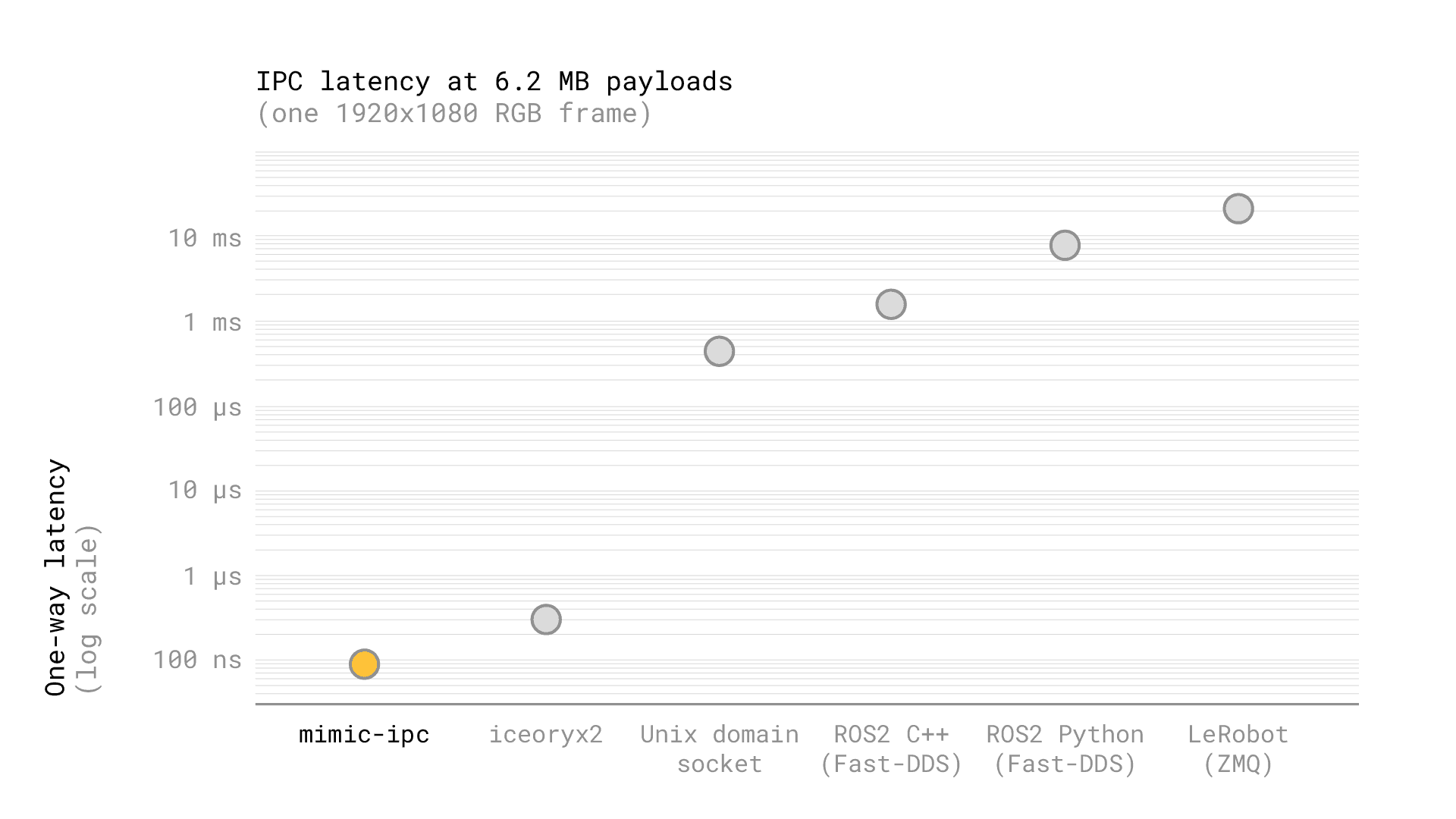
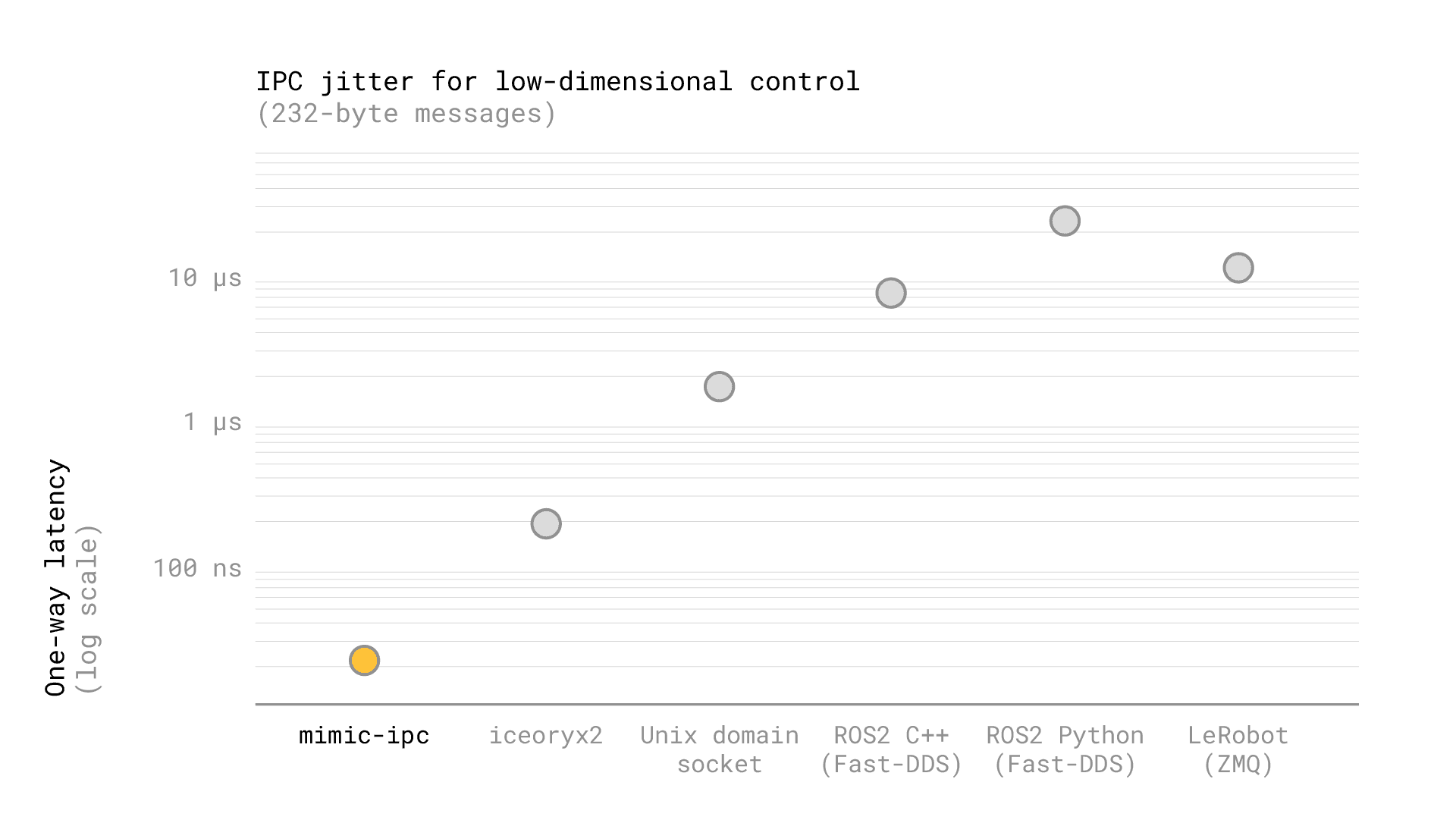
Figure: Since they pay a high serialization/deserialization cost, the high latency of conventional middleware methods is especially observable on large image payloads. Comparing HD image payloads, mimic-ipc is a significant speedup at a 89 nanosecond median latency for processes running on separate cores.
While speed is also key in control loops, the real “end-to-end killer” is jitter. On a conventional ROS2 FastDDS setup, for example, this can reach milliseconds easily for HD image payloads. Even on a low-dimensional control topic with a 232-byte payload, mimic-pc has 350x less jitter, as it keeps jitters in the nanosecond domain.
A World-class Teleoperation Stack
Teleoperation, even with its inherent limitations outlined above, will remain important in last-mile data collection, assisting fleet response and ensuring production throughput in edge case failure scenarios. Having established the bedrock of our middleware, mimic-ipc, we built fast, performant control loops for all of our arms and hands on top of it. This does not only extend to the lower-level control loops in our hands and arms, but also to all parts of our teleoperation stack.
With its 15 active DoFs, the mimic hand M1 needs precise, low-latency, and high-bandwidth human-to-robot retargeting that is beyond the current state of the art. Returning to the roots of classical model-based path planning solutions, mimic’s in-house retargeter can leverage fast, sampling-based solutions that implicitly remove the noise artifacts of currently widespread gradient-based solutions. To raise the bar for the community both in the design and the benchmarking of retargeting algorithms, we have published a snapshot of our internal retargeter state of the art.
Spotless and Zero-cost Telemetry
A verbose and interpretable recording of the system’s inner state can mean the difference between a five-minute hotfix or a week of debugging, so the fastest control loop in the world is still worthless if it is not observable. There is a tradeoff as well: as important as it is, observability can also be a trap as much as a tool. Unnecessary logging layers can steal cycles for the control loop; unstable loggers can silently drop samples or corrupt measurements. Frontier telemetry therefore, while recording everything, has to distort nothing, and cost as close to zero in compute as physically possible.
mimic’s telemetry and data recording system is built exactly for this. It reuses mimic-ipc’s zero-copy primitives, while moving actual persistence (encoding, compression, and writing out to a range of supported formats) to asynchronous processes. Crucially, observability and data collection are not two systems competing for resources, but a single, unified view of the robot. This view is not a mere post-hoc debug tool: it provides a real-time snapshot of mimic’s full fleet, allowing us to track system health and hardware performance down to the last tendon, unlocking predictive maintenance and lifecycle management of all our components.
Conclusion
Our mimic hand M1, the wearable U1, and the infrastructure that connects them are three parts of one bet: keep the human hand as a fixed morphology spec across hardware, data collection, and model training, in order to build a true general-purpose robotics foundation model and deployment platform. Developing the entire full-stack system in-house allows us to control and co-design these components to be maximally coherent, operating at the frontier of end-to-end robotics capabilities.
This technical moat enables us to pursue the development of our unique AI bet on Video Action Models, following up on mimic-video, our recent pioneering research work. Ultimately, dexterity is one of the last barriers between AI and the physical world. Solving it unlocks entire categories of physical work that automation has never been able to reach.
We will soon release an update on what comes next.